Your first ride: a beginner's guide
Prone to kneeling to standing — the proven progression for getting up and flying.
Most people get up on foil their first day. The key is to build balance at low speed before adding power.
Before you go out
Gear check
Board charged and assembled (battery, propulsion, wings)
Hand controller charged (or fresh AA batteries for the Classic controller)
Leash attached to your ankle or calf
Helmet and impact vest strongly recommended — a life jacket/PFD is recommended for beginners
Location
Calm, flat water — a lake, bay, or sheltered harbor
Deep enough that the foil won't hit bottom (at least 4 ft / 1.2 m)
Away from swimmers, docks, boats, and shallow areas
Avoid currents and heavy boat traffic for your first sessions
The progression
Step 1 — Prone
Lie stomach-down on the board, controller in your dominant hand, other hand near the nose. Gently squeeze the trigger to get moving. Spend 15–30 minutes getting comfortable steering by shifting your weight side to side.
Step 2 — Kneeling
When you're comfortable at speed, bring both knees under you. Keep your weight forward and the board flat on the water. Practice turning and speed control from your knees.
Step 3 — Standing
Place your front foot where your front knee was, then bring your back foot up in one smooth motion. Think wrestler stance: low center of gravity, knees bent, weight about 70% on your front foot. Ride on the surface first.
Step 4 — Getting on foil
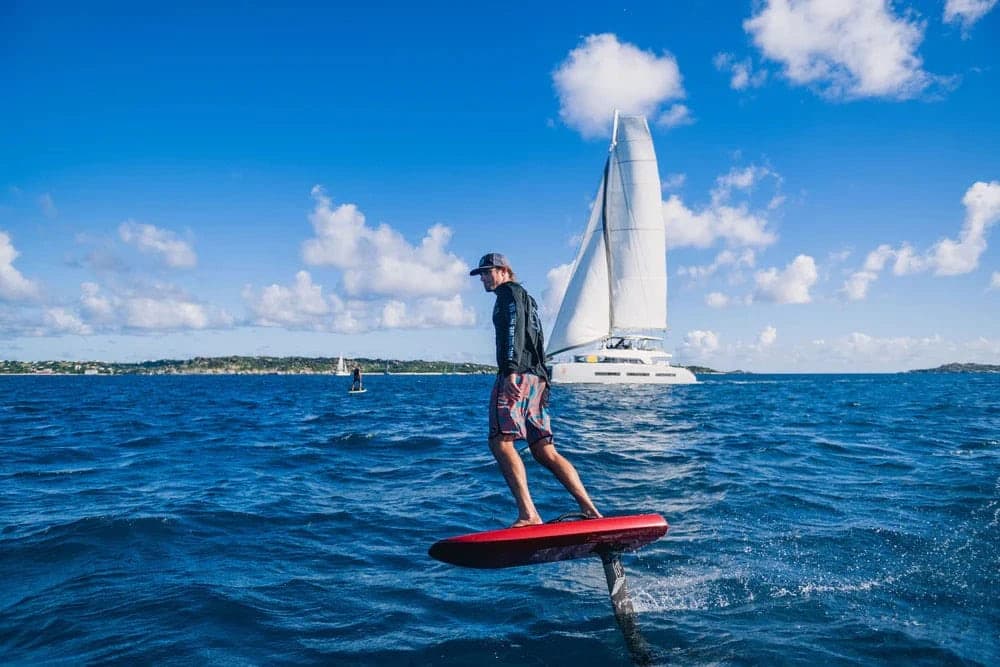
As you increase speed, the wing generates enough lift to raise the board. This is the magic moment. When the board lifts, reduce throttle slightly — you need less power to stay on foil than to get up on foil. Small weight shifts control your height.
Tips for success
Start with a bigger board — the LIFT5 Cruiser (5'4) is the most stable.
Use the Blowfish for early sessions — it adds inflatable buoyancy rails for confidence.
Start with a high-lift wing like the 270 Camber Pro or a 200/250 Surf V2.
Bend your knees — a lower center of gravity is more stable.
Look where you want to go — your body follows your eyes, so look at the horizon, not the board.
Don't death-grip the trigger — smooth, gentle inputs produce smooth rides.
Fall safely — if you lose balance, step off the back of the board, away from the propulsion.
Common beginner mistakes
Going too fast too soon — master low-speed balance first.
Standing too stiff — keep knees bent and your body relaxed.
Looking down at the board — look ahead.
Over-correcting — small, gentle weight shifts are all you need.
Starting in choppy water — flat water makes everything easier.